
How to Design a Kitchen for Heavy Indian Cooking Without Making It Look Bulky
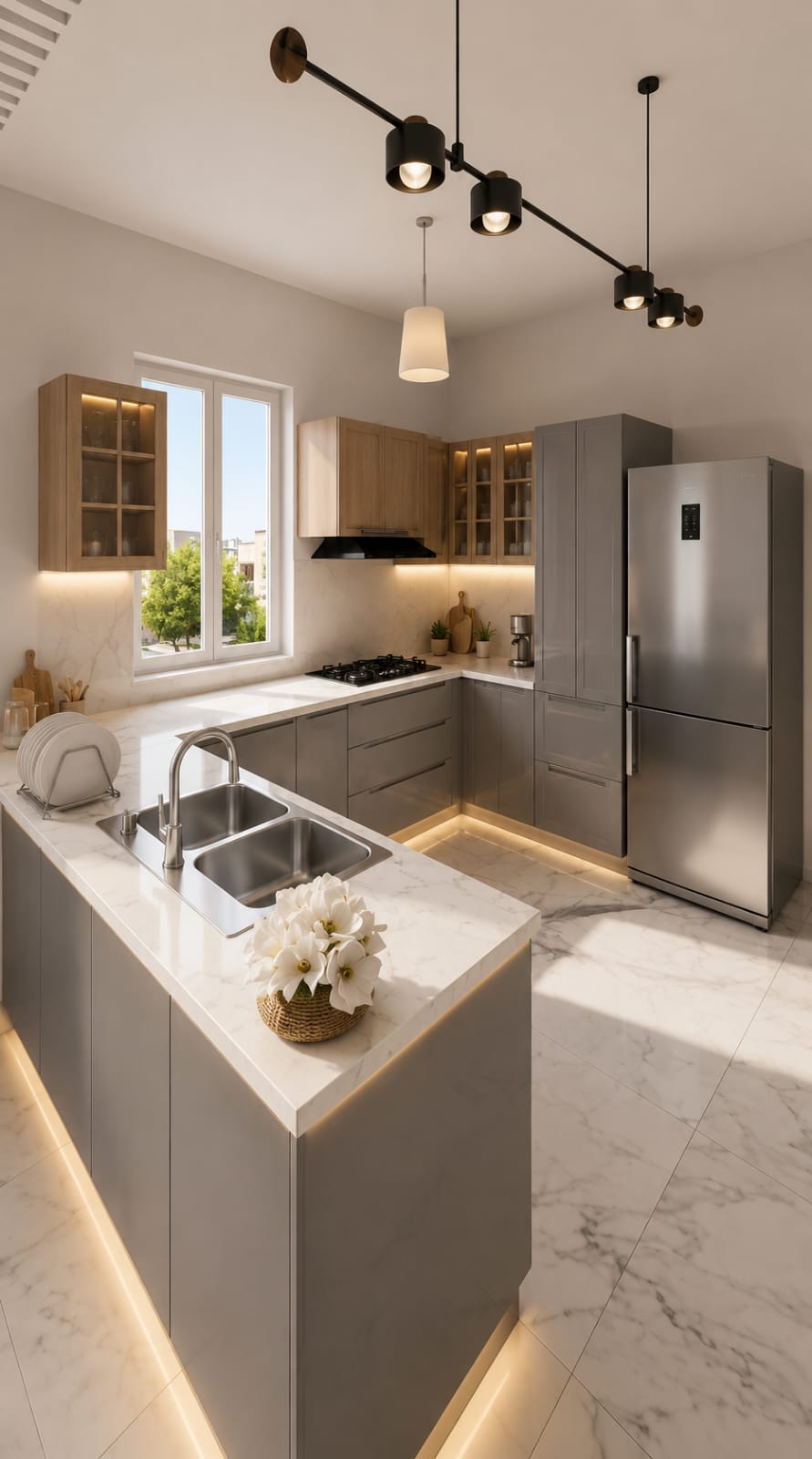
Discover how to design a modular kitchen for heavy Indian cooking with smart storage, easy-to-clean finishes, efficient ventilation and a spacious look.
A beautiful kitchen can look perfect in a photograph and still become frustrating the moment you start cooking in it every day.
For Indian households, a kitchen has to handle much more than occasional meal preparation. There may be pressure cookers, frying pans, large kadais, spice boxes, oil bottles, mixers, grinders, serving vessels and multiple ingredients being used at the same time. Add regular tadka, frying, boiling and high-heat cooking, and the kitchen needs to work much harder than it appears.
The challenge is to create a kitchen that can handle heavy Indian cooking without looking crowded, oversized or difficult to maintain.
This is where thoughtful modular kitchen design becomes important.
A well-planned kitchen does not need endless cabinets or bulky storage units. Instead, it uses the available space intelligently, keeps frequently used items within easy reach, and creates enough working space for everyday cooking.
If you are planning a modular kitchen in Haldwani, especially for a family that cooks regularly, these design decisions can make a significant difference to how your kitchen feels and functions.
What Makes an Indian Cooking Kitchen Different?
Indian cooking often involves multiple processes at the same time.
You may be chopping vegetables while something is boiling on the stove, preparing spices beside the hob and using a mixer or grinder on the countertop. Large utensils may need to be stored nearby, while frequently used oils, spices and ingredients need to remain accessible.
This creates three important requirements:
Enough preparation space, efficient storage and a comfortable cooking workflow.
A kitchen designed only around appearance can struggle with these requirements.
On the other hand, adding cabinets everywhere is not the answer either. Too much cabinetry can make the room feel visually heavy and leave very little usable countertop space.
The goal is to find the right balance.
1. Start With Your Actual Cooking Habits
Before deciding cabinet colours or finishes, think about how the kitchen will actually be used.
Ask yourself:
- How many people cook regularly?
- How frequently do you prepare meals?
- Do you use a lot of oil and spices?
- Do you regularly use a pressure cooker or large kadai?
- How often do you use a mixer grinder?
- Do you prepare multiple dishes simultaneously?
- Which utensils do you use every day?
- Which appliances stay permanently on the countertop?
These answers should influence the design.
For example, a family that cooks elaborate meals every day may need more accessible storage and preparation space than a household that primarily prepares quick meals.
This is one reason there is no single "perfect" modular kitchen design for every home.
2. Protect Your Countertop Space
One of the biggest problems in a heavy-cooking kitchen is losing countertop space to appliances and containers.
A mixer grinder, toaster, kettle, spice box, and oil bottles can quickly occupy the entire working area.
Instead of simply making the countertop larger, decide which appliances genuinely need permanent countertop space.
For frequently used appliances, consider dedicated appliance storage or accessible pull-out solutions.
The objective is to keep the primary preparation area clear.
A useful kitchen should give you enough room to:
Wash → Prepare → Cook → Serve
without constantly moving appliances and containers out of the way.
3. Create a Dedicated Preparation Zone
The area between the sink and hob is particularly valuable in a kitchen used for heavy cooking.
This is where vegetables are chopped, dough is prepared, ingredients are arranged and utensils are kept before cooking.
If this area is too small, cooking becomes uncomfortable regardless of how many cabinets the kitchen has.
During the design stage, identify the main preparation zone and protect it from unnecessary storage, decorative items and permanently placed appliances.
For homeowners planning a kitchen design in Haldwani, this is an especially important conversation to have before the final countertop dimensions are approved.
4. Use Drawers for Heavy Utensils
Large Indian utensils are often awkward to store in conventional deep shelves.
Pressure cookers, kadais, frying pans and heavy pots can become difficult to reach when they are stacked behind one another.
Deep, full-extension drawers can make these items significantly easier to access.
Instead of bending down and searching through the back of a cabinet, you can pull the drawer forward and see the contents immediately.
Different drawer depths can also be assigned to different categories:
Shallow drawers: cutlery, tools and smaller kitchen accessories.
Medium drawers: plates, bowls and everyday cookware.
Deep drawers: pressure cookers, large pots, kadais and heavier utensils.
This is a better approach than simply adding more cabinet doors.
5. Keep Daily Spices Close to the Cooking Zone
Indian cooking often involves multiple spices being added during preparation.
If the spice box is stored on the opposite side of the kitchen, you will repeatedly move back and forth while cooking.
Instead, create a dedicated storage area near the hob for frequently used spices and cooking essentials.
This does not mean placing everything beside the stove.
Heat and grease can affect certain items, and excessive storage around the hob can make the cooking area feel crowded.
The better approach is to create a nearby, organised storage zone.
A narrow pull-out unit or carefully planned drawer can keep spices, oils and frequently used ingredients accessible without making the kitchen look cluttered.
6. Plan Oil and Masala Storage Carefully
Oil bottles and spice containers are among the most frequently used items in an Indian kitchen.
They also tend to create visual clutter when left permanently on the countertop.
Instead of creating an oversized cabinet specifically for them, use compact, accessible storage close to the cooking zone.
A dedicated pull-out can be particularly useful for bottles because it makes narrow spaces functional.
The key is to design storage around frequency of use, not simply around the amount of available space.
Items you use every day should be easy to reach.
Items you use occasionally can be stored farther away.
This simple principle can make a kitchen feel much larger without actually increasing its size.
7. Design for the Mixer Grinder
The mixer grinder is one appliance that deserves special attention in an Indian kitchen.
It is frequently used for chutneys, masalas, gravies and other preparations, but leaving it permanently on the countertop can consume valuable workspace.
If it is used daily, consider creating an accessible appliance zone.
Depending on the kitchen layout, this could be:
- A dedicated countertop corner
- A pull-out appliance shelf
- An appliance garage
- A lower cabinet with easy access
The best option depends on the kitchen dimensions and how frequently the appliance is used.
The important point is to avoid designing a beautiful countertop that becomes unusable because everyday appliances have nowhere else to go.
8. Don't Cover Every Wall With Cabinets
When homeowners worry about storage, the instinct is often to add cabinets everywhere.
But a kitchen can become visually heavy when every wall is filled with overhead storage.
A better approach is to combine different types of storage.
Use closed cabinets where you need concealed storage, keep frequently used items accessible and leave some visual breathing room where possible.
This is particularly useful in smaller homes.
A kitchen can have substantial storage without looking like a wall of boxes.
Good modular kitchen design is about controlling visual weight as well as maximising functionality.
9. Choose Finishes That Work With Your Cooking Style
Heavy cooking can mean more grease, steam and frequent cleaning.
Therefore, kitchen finishes should be selected based not only on colour but also on everyday maintenance.
A finish that looks beautiful in a showroom may not necessarily be the easiest choice for a household that cooks heavily every day.
When choosing finishes, consider:
- How easily the surface shows fingerprints
- How easily grease can be cleaned
- How the finish reacts to regular cleaning
- Whether the colour will make everyday marks highly visible
- How the finish works with the overall lighting
A practical finish does not have to look boring.
With the right combination of textures, colours and cabinet profiles, a kitchen can remain visually refined while still being suitable for demanding daily use.
10. Give the Chimney Enough Attention
Heavy Indian cooking produces smoke, steam, grease and strong aromas.
That makes ventilation an important part of kitchen design.
The chimney should be selected according to the hob, cooking style and manufacturer's requirements. Its position, height, duct route and electrical connection should be planned before cabinet installation.
A chimney should not simply be added to an already finished kitchen.
This is particularly important when designing a kitchen for frequent frying or high-heat cooking.
The goal is to manage cooking by-products without making the kitchen feel overly technical or bulky.
With proper planning, the chimney, cabinets, and duct can be integrated into the overall design.
11. Create a Proper Cleaning Zone
Heavy cooking also means more cleaning.
The sink area should therefore be designed around actual daily use.
Keep frequently used cleaning products organised, provide adequate space for washing utensils, and make sure the sink does not consume the entire available countertop.
Waste management should also be considered.
A well-positioned waste bin near the preparation zone can make vegetable preparation and cooking cleanup much easier.
The best kitchen designs reduce unnecessary movement.
Instead of carrying waste across the room, washing utensils far from the preparation area, or searching for cleaning supplies, each function should have a logical place.
12. Don't Forget Large and Occasional Utensils
Indian households often own utensils that are used only occasionally but still need substantial storage space.
Large serving vessels, festival cookware, extra pressure cookers, baking equipment, and oversized pots should not be forced into everyday storage.
Create a separate zone for less frequently used items.
This prevents your daily-use drawers from becoming overcrowded.
It also makes the kitchen easier to maintain because everyday storage remains focused on the items you actually use.
A kitchen becomes easier to use when storage frequency matches accessibility.
13. Keep the Kitchen Visually Light
A heavy-cooking kitchen does not need to look heavy.
Several design choices can help:
Use a balanced colour palette
Instead of using dark finishes across every cabinet, combine them with lighter surfaces or neutral elements.
Avoid unnecessary decorative elements
Every additional feature can add visual noise.
Use consistent cabinet lines
Clean horizontal and vertical lines can make the kitchen feel more organised.
Integrate appliances where practical
Built-in or carefully positioned appliances can reduce visual clutter.
Leave breathing space
Not every wall or corner needs to be filled.
This balance is what separates a practical kitchen from a kitchen that simply has a lot of storage.
14. Design Around the Primary Cook
One of the most overlooked aspects of kitchen design is the person who actually uses the kitchen every day.
Counter height, drawer accessibility, appliance placement, and frequently used storage should be considered around the primary cook.
If someone regularly prepares meals for the family, they should not have to repeatedly bend down, stretch upward or walk across the kitchen to access basic ingredients.
This is where professional modular kitchen planning can make a meaningful difference.
The kitchen should adapt to the user, rather than forcing the user to adapt to an inefficient layout.
15. Think About the Kumaon Climate Too
For homeowners in Haldwani and the wider Kumaon region, material and construction choices deserve additional attention.
Kitchen environments naturally experience moisture, steam, and temperature changes. Regional conditions can add another layer to these considerations.
That makes proper material selection, edge protection, hardware quality and ventilation important parts of a long-lasting kitchen.
Kitchen World already focuses on material and hardware choices suited to Kumaon's climate, including moisture-resistant solutions.
The objective should not be to make the kitchen unnecessarily heavy or expensive.
It should be to choose the right construction and materials for the environment and the way the kitchen will actually be used.
A Practical Heavy-Cooking Kitchen Checklist
Before finalising your modular kitchen design, ask:
- Do I have enough uninterrupted preparation space?
- Are my daily spices close to the cooking zone?
- Where will the mixer grinder stay?
- Where will large pressure cookers and kadais be stored?
- Do I have an accessible drawer for heavy cookware?
- Are oil bottles organised without crowding the countertop?
- Is the chimney suitable for my cooking style?
- Is the sink positioned conveniently?
- Is the waste bin close to the preparation zone?
- Do occasional-use utensils have a separate storage area?
- Are the finishes easy to maintain?
- Does the kitchen still look visually open after adding all required storage?
If the answer to these questions is yes, you are much closer to a kitchen that can handle real-life cooking rather than simply looking good on a design screen.
Final Thoughts
Designing a kitchen for heavy Indian cooking does not mean filling every wall with cabinets, installing oversized storage units or sacrificing aesthetics for functionality.
The best solution is smarter planning.
Protect your preparation space. Keep everyday ingredients close to the cooking zone. Give heavy utensils proper drawers. Plan appliances carefully. Integrate the chimney correctly. Choose finishes that suit your lifestyle. And most importantly, design around the way your family actually cooks.
A well-designed modular kitchen in Haldwani should be able to handle the pressure of everyday Indian cooking while still feeling clean, spacious and visually balanced.
At Kitchen World, the focus is on creating kitchens that work beyond the first impression — combining practical planning, storage, ergonomics, materials and design to suit the home and the people using it.
Because the best kitchen is not the one with the most cabinets.
It is the one that makes everyday cooking feel easier.
Tags
Written by
Kitchen World