
Why Most Modular Kitchens Fail in Kumaon (And How to Fix It)
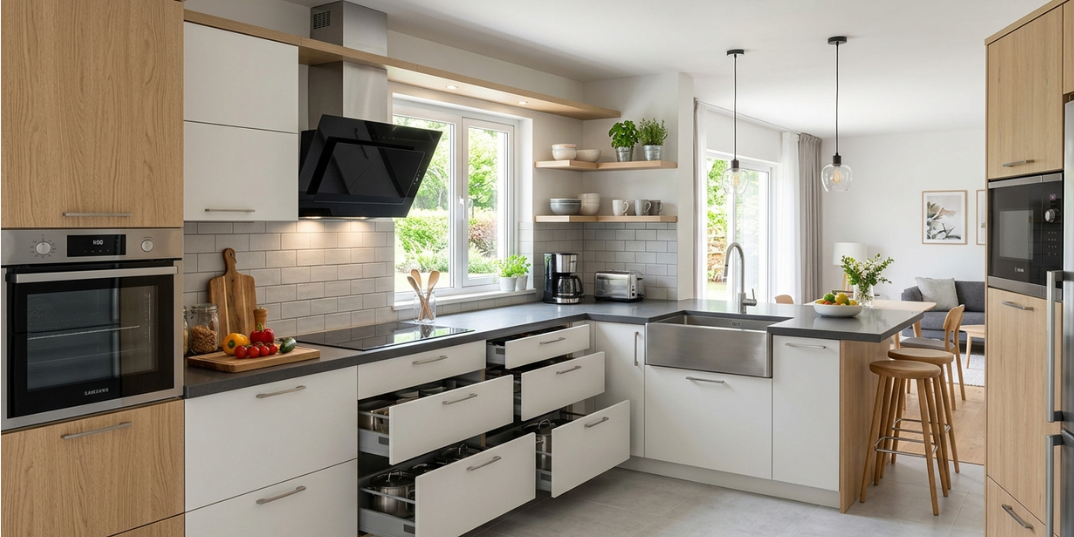
Learn why modular kitchens fail in Kumaon's humid climate and cold winters, and how to fix them using waterproof marine ply and rust-immune hardware.
The Kumaon region, with its breathtaking landscapes stretching from the foothills of Haldwani to the serene heights of Nainital, Almora, and Ranikhet, presents a unique and beautiful environment for building a home. In recent years, thousands of homeowners across this region have transitioned away from traditional masonry kitchens built by local carpenters, opting instead for the sleek appeal of modern modular kitchens.
On delivery day, these kitchens look spectacular. The premium laminate or acrylic surfaces reflect the crisp mountain light, the handles gleam, and the soft-close drawers slide shut with satisfying precision.
Yet, a troubling pattern has emerged across the hills. Walk into many modular kitchens three to five years after installation, and you will see a completely different story.
Shutters are sagging and misaligned. Base cabinets underneath the sink are swollen, emitting a musty odor. Edge-bands are peeling off, exposing the raw interior wood, and wire baskets have begun to rust, staining the inner shelves.
Why do modern kitchens fail so frequently and rapidly in the Kumaon region compared to plain urban cities? The answer lies in a fundamental disconnect: most modular kitchens are engineered for the dry, stable climates of metropolitan plains and mass-produced factory templates. They completely ignore the distinct micro-climates, high humidity, unique water properties, and cultural cooking habits of Kumaon.
Building a kitchen in this region that lasts requires moving past generic showroom catalogs and understanding the environmental forces at play. This exhaustive guide explores exactly why kitchens fail in Kumaon and how to structurally engineer a kitchen that thrives in this unique environment.
1. The Hidden Enemy: High Humidity, Severe Winters, and Condensation
The single greatest threat to any modular kitchen in Kumaon is the region's climate. From heavy, continuous monsoon downpours to intense winter cold, the levels of atmospheric moisture fluctuate dramatically throughout the year.
The Condensation Phenomenon
In colder areas like Bhimtal, Mukteshwar, or Almora, a major physical challenge occurs during winters: internal condensation. When you boil water for tea or cook deep mountain stews, a large volume of hot steam is released into the room.
When this warm, moisture-laden air hits the freezing cold exterior walls of your home, it instantly turns back into liquid water.
If your kitchen cabinets are pushed directly against these outer stone or brick walls without a protective barrier, moisture gets permanently trapped in the narrow gap behind the back panel. Because there is zero airflow in that dark space, a dangerous micro-climate develops.
How Standard Factory Materials Fail
Most low-cost modular kitchen dealers in the region import pre-fabricated cabinets made from compressed particleboard or standard Medium-Density Fiberboard (MDF). These materials consist of fine wood particles or fibers bound together with chemical resins under heat and pressure.
When trapped wall moisture or airborne condensation touches the edges of particleboard or standard MDF, the loose internal fibers absorb the water like a sponge.
-
Internal Swelling: Once moisture penetrates the core, the compressed fibers expand, causing the entire panel to swell and warp.
-
Loss of Screw-Holding Capacity: As the core material turns soft and flaky from moisture, the heavy screws holding your cabinet hinges pull out entirely. This is why shutters begin to sag and can no longer be aligned.
-
Mold and Mildew Growth: The trapped dampness behind compressed boards creates a perfect breeding ground for toxic black mold, ruining your expensive storage spaces and compromising food safety.
2. The Kitchen Skeleton: Specifying the Kumaon-Grade Carcass Materials
To fix the moisture problem permanently, you must abandon plain-land material specifications. For a kitchen to survive a decade in Kumaon, the core structural skeleton must be built from materials engineered specifically for high moisture and thermal stability.
The Foundation: BWP Marine Plywood
For all base cabinets—and absolutely mandatory for the sink cabinet, dishwasher area, and any unit touching an exterior wall—you must specify true Boiling Water Proof (BWP) Marine Plywood.
True BWP plywood is manufactured using selected hardwood veneers bonded with un-extended phenol-formaldehyde resin under extreme hydraulic pressure.
Unlike particleboard, it features an organic, cross-layered solid wood grain structure. It can withstand prolonged immersion in water and continuous exposure to extreme humidity without losing its shape, delaminating, or sacrificing its structural strength.
The Wall Alternative: High-Density HMR Boards
For dry overhead wall cabinets that do not share an exterior wall, you can utilize high-density High-Moisture Resistant (HMR) boards or exterior-grade High-Density Fiberboard (HDF). These boards are blended with specialized hydrophobic resins throughout the core, ensuring that even if steam rises directly from your stovetop during deep cooking, the panels remain completely stable.
The Defensive Solution: Air Gaps and Back-Panel Sealing
Never allow your installation team to mount cabinet carcasses flush against a raw plaster wall. A professional installation requires mounting the cabinets with a mandatory 5mm to 10mm defensive air gap using specialized heavy-duty brackets.
Furthermore, the back panel of the cabinet should be treated with water-resistant PVC backing sheets, and all wall-facing joints must be completely sealed with structural silicone sealant to prevent dampness from traveling forward into your storage zones.
3. Water Chemistry and the Crisis of Early Hardware Rust
Another major regional factor that most designers completely overlook is the chemical composition of water in Kumaon. Depending on whether your home relies on natural mountain springs, deep borewells, or local gravity supply lines, the water frequently contains high levels of dissolved minerals, iron, or hard calcium.
The Breakdown of Cheap Wire Baskets
Many homeowners choose traditional pull-out stainless steel wire baskets for their lower cabinets because they look simple and cost-effective upfront. However, hard water combined with high atmospheric humidity triggers rapid chemical oxidation.
When wet plates or freshly washed vegetables are placed near standard chrome-plated wire baskets, the hard water strips away the thin outer protective layer. Within two to three years, rust blooms across the joints.
The rust quickly creates rough surfaces that catch dirt, making the baskets incredibly difficult to clean and eventually ruining the smooth glide of the side rollers.
The Fix: Advanced Tandem Boxes and Grade SS304 Hardware
To ensure your internal drawer systems pull out smoothly year after year, your layout must move away from basic wire designs:
-
Solid-Walled Tandem Boxes: Switch to premium, solid-walled tandem box systems coated in fingerprint-resistant, anti-corrosive powder finishes. These solid metal walls protect your items and keep any accidental spills contained within a wipe-clean surface.
-
Certified SS304 Grade Components: If you prefer wire organizers for specific spice racks, demand absolute verification that the material is SS304 grade stainless steel. This specific alloy contains high percentages of chromium and nickel, creating a self-healing surface layer that completely resists hard water rust.
-
Tested Hydraulic Hinges: For cabinet shutters, utilize globally certified soft-close hinges rated for a minimum of 200,000 opening cycles. Ensure the internal hydraulic cylinders use high-viscosity silicone oils that will not freeze, stiffen, or leak during sub-zero winter temperatures in the hills.
4. The Pitfalls of Sub-Optimized Local Planning
Building a modular kitchen in Haldwani or the surrounding hill towns requires careful execution. A major reason kitchens fail functionally is that homeowners often rush into purchasing materials or hiring general contractors before mapping out the technical design sequence.
When civil construction, plumbing lines, and electrical points are laid out without a professional kitchen blueprint, major errors happen—such as water drainage outlets clashing with solid drawer paths or heavy chimney vents running through structural roof beams.
A beautiful kitchen requires a highly calculated, step-by-step methodology where structural civil work, utility positions, and final cabinet execution are synchronized perfectly.
Design Tip: To see exactly how an enduring kitchen moves from initial spatial concept to technical material sourcing and final on-site installation without errors, explore our step-by-step methodology. Read More: How We Plan
5. Thermal Stress and Countertop Cracking
The Kumaon region experiences significant temperature differentials. A kitchen counter can be extremely cold in the morning, but then face intense, concentrated heat when hot cast-iron vessels or deep frying pans are placed on it during meal preparation.
The Danger of Low-Grade Engineered Stones
To save costs, some local vendors install cheap, low-density engineered stones or unverified quartz brands. These lower-tier slabs contain high amounts of plastic polyester resins mixed with stone dust.
When a blazing hot pan is placed directly onto a cold, resin-heavy countertop, the sudden localized heat causes rapid thermal expansion.
Because the cheap slab lacks structural elasticity, it cracks across the weakest point—usually starting from the sink cut-out or the stovetop edge. Once a countertop cracks, water seeps directly down into the wooden cabinets below, destroying the core framework.
The Fix: Dense Indian Granite or Premium Quartz
To withstand severe thermal shock, your countertop material must have high natural density and low chemical resin content:
-
Premium Low-Porosity Granite: Dark Indian granites remain a gold standard for durability. They are naturally dense, virtually non-porous, completely unaffected by extreme temperature changes, and cannot be scratched by steel kitchen knives.
-
High-Quality Engineered Quartz: If your design calls for a minimalist solid color, opt for premium quartz surfaces composed of 90% to 93% pure natural quartz crystals bound with specialized structural resins. These surfaces are non-porous and can easily withstand daily kitchen use without staining or cracking.
6. Cultural Cooking Habits vs. Delicate Foreign Designs
Many modular kitchens fail because they are designed straight out of European interior magazines that assume an entirely different lifestyle. European designs are meant for light meal assembly, microwave cooking, and minimal oil usage.
In contrast, traditional cooking in Kumaon involves heavy vessels, grinding robust spices, high-heat tadkas, and long hours of simmering food.
The Failure of Delicate Finishes and Manual Edge-Banding
Using delicate, high-maintenance finishes like thin PVC foils or low-grade manual laminates in an intense cooking environment is a recipe for early wear.
When heavy steam and airborne grease from high-heat cooking rise constantly, they settle on the cabinet surfaces.
If the edge-banding on your cabinet shutters was applied manually using basic workspace glues, the rising heat dries out the adhesive layer. Within a few seasons, the edges peel open, allowing grease and water vapor to rot the internal board.
The Fix: PUR Hot-Melt Technology and Durable Finishes
Your kitchen exterior must be engineered like a protective shield:
-
PUR Automated Edge-Banding: Ensure every single shutter panel is edge-banded using industrial PUR (Polyurethane) hot-melt adhesive on fully automated edge-banding machinery. PUR forms a permanent chemical bond with the wood core that is completely immune to water vapor, steam, and high temperatures, ensuring the edges never split open.
-
High-Pressure Laminates (HPL) or Premium Acrylics: For maximum durability, choose thick, high-pressure laminates or premium scratch-resistant acrylics. These surfaces can be wiped clean with a damp microfiber cloth without leaving permanent scuffs or absorbing turmeric oil stains.
7. Maximizing Value: Avoiding the Traps of Unverified Quotes
When planning your kitchen, it is easy to get overwhelmed by conflicting quotes from local dealers across Haldwani. Many vendors quote incredibly low prices by showcasing a stunning exterior but quietly using cheap materials for the internal parts you cannot see.
Investing your budget wisely means prioritizing durable internal carcasses and certified mechanical hardware over flashy external looks. Spending heavily on expensive glass panels while cutting corners on basic waterproof plywood will inevitably lead to structural wear and costly rebuilds within just a few years.
Design Tip: To understand how to properly analyze kitchen costs in the local market and avoid hidden material downgrades, read our comprehensive cost analysis guide. Read More Blog: How To Build A Kitchen That Still Looks New After 10 Years
Summary Checklist for Building an Enduring Kumaon Kitchen
Before signing any contract or approving a design blueprint for your home in Kumaon, ensure your layout meets these five non-negotiable standards:
-
Mandatory BWP Carcass: Require 100% Boiling Water Proof marine plywood for all base units, especially around plumbing points.
-
Defensive Air Gaps: Maintain a 5mm to 10mm gap between the cabinet backs and exterior walls to prevent dampness transmission.
-
Industrial PUR Edges: Ensure all shutter perimeters are sealed using automated PUR hot-melt adhesives to resist steam and heat.
-
Rust-Immune Hardware: Specify powder-coated tandem drawer systems and certified SS304 stainless steel hardware for long-term smooth operation.
-
High-Density Countertops: Choose premium low-porosity granite or high-grade quartz to handle daily thermal shifts without cracking.
By designing your kitchen around the reality of Kumaon’s unique climate, water quality, and rich culinary traditions, you can create a beautiful workspace that performs flawlessly and looks brand new for a decade and beyond.
🔴 SCHEDULE YOUR ERGONOMIC KITCHEN AUDIT IN KUMAON
Planning to build a premium modular kitchen that stands up to the mountain climate? Bring your architectural drawings to our showroom for a thorough material-engineering review.
-
Call / WhatsApp: +91 8979123945
-
Visit Our Showroom: Kaladhungi Road, Haldwani, Uttarakhand
-
Explore Our Regional Projects: www.kitchenworldhaldwani.com
Tags
Written by
Kitchen World