
The Ultimate Maintenance Guide for Modular Kitchens in Haldwani: 5 Expert Strategies to Combat Hard Water and Rust
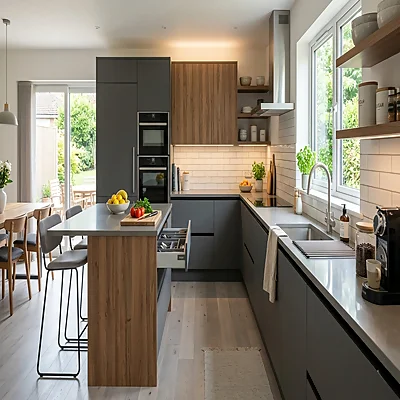
"Stop hard water from ruining your Haldwani kitchen. Learn expert tips to prevent lime scaling and rust in Kumaon homes. Protect your Kitchen World investment!"
The Ultimate Maintenance Guide for Modular Kitchens in Haldwani: 5 Expert Strategies to Combat Hard Water and Rust
The Hidden Enemy of Kumaoni Kitchens
You’ve invested significantly in a premium modular kitchen for your home in Haldwani, Bhimtal, or Nainital. It looks breathtaking on day one. But as any local resident knows, there is a silent enemy lurking in our taps: Hard Water. In regions like Kusumkhera and Mukhani, the groundwater is exceptionally rich in "Chuna" (Calcium Carbonate and Magnesium). These minerals leave behind stubborn white scales—a process known as limescale—which triggers rapid oxidation on metal surfaces and clogs the delicate hydraulic mechanisms of high-end hardware.
Without a professional, long-term maintenance strategy, even a multi-lakh investment can lose its functionality within 24 months. According to industry-standard maintenance protocols, "In high-TDS (Total Dissolved Solids) zones, 80% of hardware failure is caused by mineral calcification rather than physical wear." This guide provides the timely, essential engineering knowledge you need to protect your investment for decades.
1. The Chemistry of Limescale: Managing Mineral Deposits on Surfaces
In Haldwani and the Kumaon foothills, the water hardness often exceeds 300-500 ppm. When this water evaporates on your stainless steel sinks, faucets, or the edges of your shutters, it leaves a crystalline mineral deposit.
The Destruction Cycle
These white scales are alkaline. Over time, they create a chemical bond with the surface finish of your hardware. If you try to scrape them off later, you end up removing the protective chrome or nickel coating, exposing the raw metal to oxygen. This is how "pitting" starts.
The Solution: The "Immediate-Dry" Protocol
The secret to longevity isn't expensive cleaners; it's the Scientific Dry-Wipe. After every dishwashing session, you must wipe your sink and surrounding hardware with a dry microfiber cloth.
Expert Quote: "Mineral deposits act like sandpaper on soft-close mechanisms. Keeping your hardware bone-dry is the single most effective way to extend its life by 50%." — Kitchen World Technical Specialist.
-
Key Takeaway: Never let tap water air-dry on your modular components; the minerals left behind are the primary cause of surface corrosion.
💡 Pro-Tip: For existing scales, use a 1:1 solution of white vinegar and water. The acetic acid in vinegar neutralizes the alkaline calcium without damaging the metal.
2. Hardware Engineering: Protecting Hinges from "Atmospheric Rust"
The moisture levels in Bhimtal and Nainital, combined with the hard water used for floor mopping, create a "corrosion cocktail" inside your base cabinets. Most local "carpenter-made" kitchens use Zinc-plated or low-grade steel hinges that begin to creak and rust after the very first monsoon.
The SS 304 vs. SS 201 Debate
At Kitchen World, we exclusively utilize SS 304 Grade Rust-Proof Hardware. Grade 304 contains a high percentage of Chromium and Nickel, which forms an invisible "passive layer" of chromium oxide that prevents rust. However, in Haldwani’s climate, even this layer needs care.
The Lubrication Science
Every 6 months, apply a tiny drop of silicone-based lubricant to the hinge joints. Avoid using heavy household oils like mustard or coconut oil. Why? Because organic oils go rancid, become sticky, and eventually attract dust that jams the soft-close hydraulics.
-
Key Takeaway: Rust-proof hardware like SS 304 is essential for Kumaon, but it still requires the removal of salt deposits to maintain its smooth motion.
💡 Pro-Tip: If a hinge starts making a "clicking" sound, it likely has mineral buildup. Clean it with a soft nylon brush before applying a professional-grade lubricant.
3. Surface Science: Avoiding the "Scrubbing" Disaster
Many homeowners in Haldwani make a fatal mistake: using harsh abrasive pads (like green scrubbers or steel wool) or strong chemical acids to clean "turmeric" or oil stains from their laminates.
The Micro-Scratch Effect
Abrasive pads create millions of microscopic scratches on your glossy or matte shutters. These scratches then become "traps" for oil and turmeric. This is why some kitchens look "yellowed" or "dirty" no matter how much you clean them—the dirt is literally trapped inside the scratches you created.
The Solution: Non-Abrasive Cleaning and pH-Neutral Care
For high-gloss acrylic or premium laminates, use only soft cotton or microfiber.
Expert Insight: Understanding the material science behind your kitchen prevents permanent damage. High-quality light-colored kitchens are highly practical if you avoid the "scrubbing" culture.
Further Reading: 👉 Is White Laminate Practical for Indian Homes? Myths & Realities for Haldwani Homeowners
-
Key Takeaway: Abrasive cleaners destroy the protective UV layer of your laminates, leading to permanent yellowing and loss of shine.
💡 Pro-Tip: For stubborn "Haldi" stains, make a paste of baking soda and water, leave it for 5 minutes, and wipe it off gently. Baking soda is a natural, non-abrasive whitener.
4. The "Seelan" Defense: Managing Humidity in Hill Cottages
In Bhimtal and Nainital, humidity is a year-round resident. In small, poorly ventilated kitchens, moisture gets trapped inside closed cabinets, leading to fungal growth, musty smells, and the eventual swelling of the wood core.
The Ventilation Vacuum
Many homeowners keep their cabinets shut for weeks, especially in vacation homes. This creates a "stagnant air" environment where mold thrives.
The Solution: Air Circulation and Desiccants
Once a week, leave your cabinet shutters open for 30 minutes to allow fresh air to circulate. We also recommend placing silica gel canisters or moisture-absorber boxes in the corners of your pantry and under-sink units.
-
Key Takeaway: Stagnant air inside a cabinet is the leading cause of "internal rot," even if the exterior looks perfect.
💡 Pro-Tip: Ensure your chimney is serviced every 4 months. A clogged chimney allows oily steam to settle back onto your cabinets, creating a sticky layer that traps moisture and dust.
5. Strategic Planning: Why Material Selection is the Best Maintenance
The best way to "maintain" a kitchen is to build it with materials that don't require constant attention. In the Haldwani and Kumaon region, this means moving away from traditional carpentry.
The WPC Advantage for Sink Zones
If you are planning a renovation, ensure your "wet zones" (sink area) are made of WPC (Wood Plastic Composite). While traditional wood rots with hard water exposure, WPC is 100% waterproof.
Expert Warning: Using the wrong materials in the Himalayan climate is the most expensive mistake a homeowner can make.
Further Reading: 👉 95% of Kitchens in Kumaon Get Damaged Faster: Why Smart Modular Design Matters
The "No-Slab" Renovation
If you have an old concrete kitchen in Haldwani that smells of dampness, you don't need to break the stone. You can upgrade to a modular system with rust-proof hardware to eliminate the "old stone" smell and improve hygiene.
Further Reading: 👉 Kitchen Renovation: Converting Old Concrete to Modular in Haldwani
6. Managing the Hard Water "TDS" at the Source
If your home in Kusumkhera or Mukhani has extremely hard water, maintaining your modular kitchen will always be an uphill battle. We recommend installing a "Whole House Water Softener" or at least a "Point-of-Use" softener for the kitchen tap.
How Softeners Help
By replacing Calcium and Magnesium ions with Sodium ions, a softener prevents the formation of limescale entirely. This keeps your SS 304 hardware shiny and ensures that your soft-close hinges never lose their "glide."
7. Professional Deep Cleaning vs. Daily Care
While daily wiping is essential, a modular kitchen requires a "Deep Audit" every 12 months.
-
Check for Loose Screws: Vibration from chimneys and heavy drawers can slightly loosen screws over time.
-
Verify Alignment: In the hills, minor structural shifts can cause doors to go "out of plumb." Adjusting the hinges early prevents damage to the cabinet frame.
-
Hardware Degreasing: Removing the fine layer of kitchen grease from hinges ensures the hydraulic fluid stays clean.
Conclusion: Preserve Your Investment with the Experts
A modular kitchen is an investment in your family's health and happiness. At Kitchen World, we don't just install kitchens; we ensure they stay beautiful for a lifetime. We understand the "Chuna" in Haldwani’s water and the "Seelan" in the hills of Nainital. Stop the damage before it becomes permanent.
Further Reading & Resources
🔴 REQUEST A PROFESSIONAL MAINTENANCE AUDIT
Is your modular kitchen losing its shine? Stop the damage before it becomes permanent. We offer a Professional Maintenance Audit & Deep Cleaning Consultation (Worth ₹4,999) for homeowners in the Haldwani region.
👉 Request a Maintenance Health-Check Now
📞 Call/WhatsApp: +91 89791 23945 📍 Showroom: Kaladhungi Road, Haldwani.